
How do elephants know?
As I sit in Dallas thinking about our recent trip to Elephant Havens, I find myself reflecting on what to share with all of you who have made this crazy dream of ours a reality. And then something came to me—the mystery of how elephants know what they know.
I am often bewildered by the actions of our baby elephants. Some things simply cannot be explained in ordinary terms. Many evenings, as the day winds down at the orphanage, I sit quietly with the elephants and find myself asking the same question:
How do they know?
When we first drive through the main gate after arriving at the orphanage, there are often no elephants in sight. Then, suddenly, I glance behind the vehicle and there is precious little Joy racing after us.

No nannies nearby. No one guiding her. But, somehow, she knows I am in that vehicle and wants to greet me with her endless trunk hugs and kisses.
Of course, I immediately tell Bee, “Stop, stop, stop!” and jump out to be showered with love and elephant kisses. There will never be words that adequately express the joy of seeing that little one waiting to welcome me home.
But how did Joy know I was here?
Perhaps there are scientific explanations. Elephants have an extraordinary sense of smell—far greater than a dog’s—and maybe she caught my scent as we drove through the gate. (I call it my “Africa scent”, the one I acquire when I’ve been traveling for two days to reach Botswana.)

How do our newest arrivals know they’re safe?
I often think back to MmaMotse, our very first rescued orphan. It took months before we felt she had accepted our care and trusted us enough to roam freely around the property with us by her side.
Today, our newly rescued babies somehow seem to understand almost immediately that they are safe. Often within hours of them arriving, our caregivers can enter their enclosures, and the babies will eat from their hands right away.
Perhaps that, too, has an explanation. Elephants have their own complex language, both their trumpets and rumbles as well as infrasound—low-frequency sounds that are too deep for human ears to detect. Are our older orphans communicating to the newcomers that they are safe, loved, and have found a beautiful new home? Possibly.
Whatever the reason, it is still miraculous to witness.
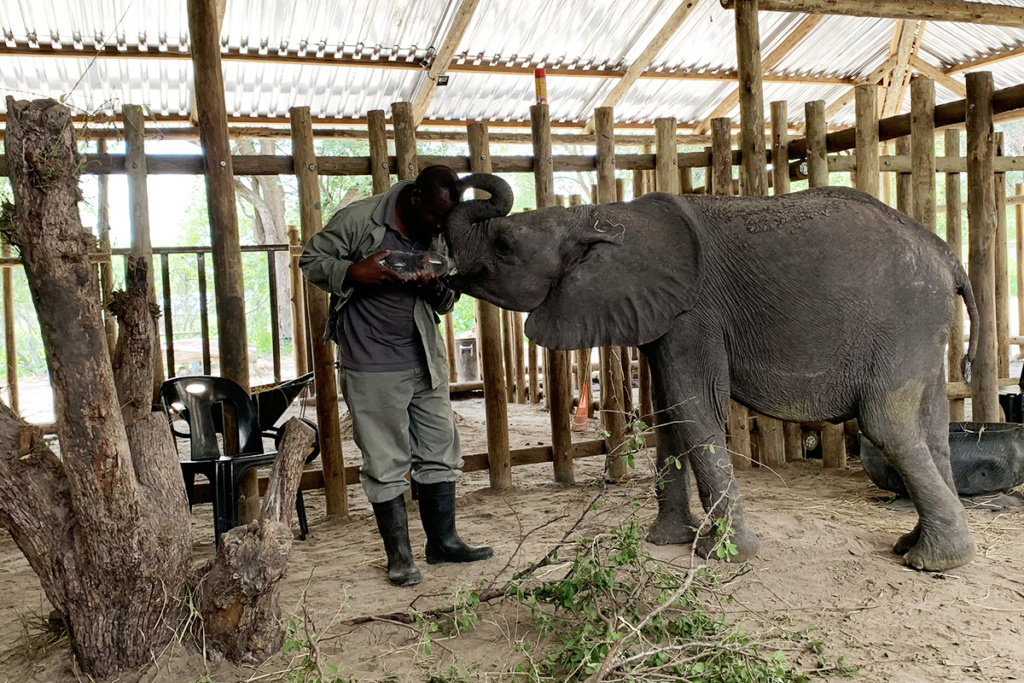
How did they know we could help?
Then there is little Tsi Tsi, the baby without a tail. After suffering an attack by hyenas, her tail was bitten off and she sustained severe injuries. She was found just outside our main camp, escorted by three bull elephants who appeared to have brought her directly to our doorstep, as if they were saying, “This baby needs you. We’ve brought her to the right place.”
It is difficult to explain moments like these. How did they know where to bring her? How did they understand that help was available? We may never fully understand the depth of how elephants think, feel, and connect with each other, but stories like Tsi Tsi’s remind us that there is so much about these extraordinary animals that we are still learning.
Today, Tsi Tsi is thriving, a living testament not only to her own resilience but also to the incredible bonds that exist within elephant society.

So how do these magnificent creatures know any of these things?
My unscientific explanation is that elephants possess more intelligence, more empathy, and more capacity for love than we can fully comprehend.
Every visit teaches me something new. Every rescue reminds me how much we still have to learn from these remarkable animals.
I only wish all of you could sit beside me in the sand under a shade tree and witness these extraordinary creatures for yourselves.
Thank you for making this work possible. Thank you for giving these little ones a second chance at life. Most of all, thank you for being part of their story.
With much gratitude,
Debra
Add Comment